How to Clean a Burnt Pan on an Induction Hob: What Works and What Doesn't
As an Amazon Associate we earn from qualifying purchases. Some links on this page are affiliate links, which means we may earn a small commission if you make a purchase.
The burnt residue you’re trying to remove could be on the pan base or the hob glass — and the right cleaning approach depends entirely on which surface you’re tackling. Pan-base residue needs pan-side methods, while hob marks require specific glass-safe techniques. This guide focuses on the hob side of the problem.
A dark ring stares up at you from the induction hob, where the pasta sauce boiled dry. Your first thought is the cost of the hob, and your second is the internet’s dire warnings about scratching the glass.
This is almost always fixable. That mark is probably burnt-on food residue, not damaged glass, and you can remove it with what you already own. Here’s what actually works, what doesn’t, and the one rule that stops you making it worse.
Identifying the Stain
Before you reach for a cleaner, it helps to know what you’re dealing with. The fix depends on it.
Induction hobs heat the pan directly through an electromagnetic field, not the glass surface itself. What you’re seeing is rarely heat damage to the glass. More often it’s one of two things:
A heat mark — a dull grey or iridescent ring that sits on the surface. This forms when the hob stays hot under the pan and the glass changes slightly in that spot. It doesn’t wipe off with a cloth, but it’s cosmetic, not damage.
Or burnt-on residue — sticky black crumbs or a crusty black ring. This is food or cooking oil that transferred from the base of the pan when it boiled dry or spilled, then carbonised onto the glass. This is what needs proper removal.
Sugary spills are the worst. Anything with sugar — a jam pan, a sweet sauce, even milk that boiled over — burns fast and bonds hard to the glass. Leave it and it becomes much harder to shift.
Is it a dull grey ring or a sticky black crust? The difference matters. Heat marks respond to different treatment than carbonised residue.
How Induction Changes the Cleaning Game
Induction cooking brings specific cleaning challenges. The concentrated heat can cause spills to carbonise quickly. A warped pan base — even slightly — doesn’t sit flat on the glass. The gap means heat concentrates in one spot, and that spot burns harder and deeper than the rest. If your pan has always left uneven cooking marks, that is the sign.
For the cleaning methods that follow, the flat base rule applies when you are using heat-based approaches. A pan with a warped base won’t distribute heat evenly, so the cleaning method works unevenly too.
The other thing worth knowing: induction hobs stay hot longer than they look. Wait until the hob has cooled before cleaning, following the appliance manual.
Avoid cleaning a hot surface and follow the manufacturer’s cooling instructions.
Effective Cleaning Methods
Right. The stain is carbonised residue, the hob is warm but not hot, and you need to shift it. Here is what actually works, in order of approach.
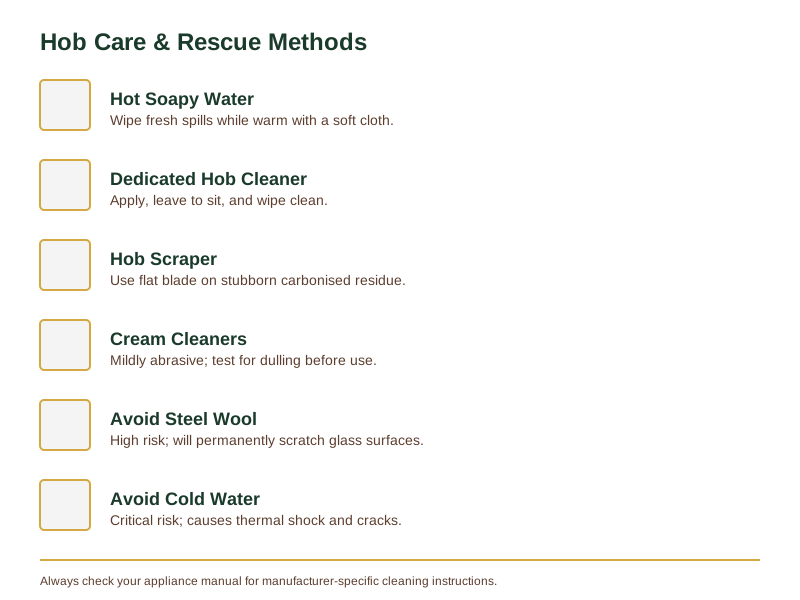
Hot soapy water and a soft cloth
For light spills caught quickly, this is enough. Wipe while the surface is still warm (not hot), using a soft damp cloth with a drop of washing-up liquid. It dissolves the residue before it fully carbonises.
This doesn’t work for anything that has already turned black and crusty. Once sugar or oil has carbonised, soapy water won’t touch it.
A dedicated hob cleaner
Use a cleaner specifically labelled as suitable for your hob and follow its instructions. For light to moderate marks this is a reasonable first step. For the heavy black ring from a pan boiled dry, it will probably shift the surface grime but leave the core stain.
A hob scraper
This is the one that actually works on persistent carbonised residue. A hob scraper — a flat plastic or metal blade designed for glass cook surfaces — physically lifts the burnt-on layer from the glass. You hold it flat against the surface and push, letting the blade do the work.
In my judgement the pattern is this: cleaners improve the look, but a scraper does the actual removal of what is left, such as a greasy film.
The catch is technique. Hold the scraper at the wrong angle or press too hard and you will scratch the glass. The blade should be flat, the pressure light, and the movement deliberate. Test on an inconspicuous corner first.
Cream cleaners
Some cream cleaners can be used on induction hobs if explicitly labelled for glass-ceramic surfaces. They are effective at breaking down staining on hard surfaces. For hob use, the pattern is mixed: they can work on light to moderate marks, but the abrasiveness means you risk micro-scratches if you scrub too hard or use them regularly.
Test on a hidden corner. If you see any dulling of the surface shine, stop.
Methods to Avoid
Steel wool, abrasive scouring pads, and any scourer with a green abrasive side will scratch induction glass. Plain and simple. The scratches will not come out, and they will make future cleaning harder.
Vinegar and bicarbonate paste (paid link)See on Amazon can lift light films, but for properly carbonised residue it’s less effective. Fine for maintenance, not for the job in front of you.
The honest call for a burnt ring from a pan boiled dry: start with a dedicated hob cleaner to soften the surface, then use a scraper for the stubborn bits. It is the combination that works.
Preventing Future Marks
Once you have got it clean, you don’t want to be back here next month. A few habits make a real difference.
Lift pans rather than sliding them. Even on a flat glass surface, dragging a pan — especially one with a rough or uneven base — can leave marks over time.
Keep the base of your cookware dry and clean before you put it on the hob. A damp base from washing up, or one with food residue stuck to it, is more likely to cause staining.
Wipe spills immediately when they happen. A pan that boils over for thirty seconds is a five-second wipe. Left for ten minutes, it is a ten-minute job.
Your Questions Answered
Can I use steel wool on my induction hob?
No. Steel wool is abrasive and will scratch the glass surface. Once scratched, the damage is permanent and will make the hob harder to keep clean going forward.
Will cream cleaners scratch my induction hob?
They can do. Cream cleaners are mildly abrasive and work well on some surfaces, but on glass the abrasiveness can leave micro-scratches. Test it on a corner of the hob first, and if you see any dulling, use a non-abrasive cleaner instead.
My hob looks stained after cleaning. What’s left?
Two possibilities. First, it could be a heat mark rather than residue — a slight change in the glass surface itself from localised overheating. These don’t wipe off with cleaner or scraper; they’re cosmetic. Second, it could be mineral deposits from hard water. A dedicated hob cleaner formulated for this is the best bet.
Can I pour cold water on a warm hob?
No. Avoid cleaning while hot; follow the hob manufacturer’s instructions.
How often should I clean my induction hob?
Wipe after every use — a quick pass with a soft cloth removes most spills before they carbonise. A proper clean with hob cleaner once a week, or after a significant spill, keeps the surface in good condition.
Quick Reference Table
| Method | Best For | Risk Level | Key Action |
|---|---|---|---|
| Hot Soapy Water | Light, fresh spills | Low | Wipe while warm with soft cloth |
| Dedicated Hob Cleaner | Surface grime and light marks | Low | Apply, leave, wipe clean |
| Hob Scraper | Stubborn, carbonised residue | Medium | Flat blade, light pressure, test corner first |
| Cream Cleaners | Light to moderate stains | Medium-High | Mildly abrasive; test for dulling before use |
| Vinegar & Bicarbonate Paste | Light films only | Low | Less effective for heavy burns |
| Steel Wool / Green Scourers | Never | High | Will permanently scratch glass |
| Cold Water on Warm Hob | Never | Critical | Avoid cleaning while hot |
Final Thoughts
Pan-base residue belongs to pan care, while hob marks belong to hob care. For the pan-side of the equation — whether it’s a cast iron skillet gone rusty, a stainless saucepan with a scorched base, or a non-stick that has lost its coating — our main guide on How to Clean a Burnt Pan: Stainless Steel, Aluminium and Pots covers the material-specific methods you’ll need.
Now you know what to try first — Download the Free Pan Rescue First-Steps Checklist to keep the steps to hand for next time.
Note: General guidance only, verify details with a qualified professional or official source.
Sources & Further Reading
Related Guides
For a complete overview, see our How to Clean a Burnt Pan: Stainless Steel, Aluminium and Pots .
📺 Watch: Clean your Burnt Glass Hob: Hob Scraper Razor + this Homemade …