How to Clean a Burnt Pan Without Harsh Chemicals: Natural Methods That Work
As an Amazon Associate we earn from qualifying purchases. Some links on this page are affiliate links, which means we may earn a small commission if you make a purchase.
Bicarbonate of soda has a pH of around 9, white vinegar sits at about 2.5. Common burnt food residue, particularly carbonised sugars and proteins, typically falls within a pH range that makes it vulnerable to attack from both acidic and alkaline solutions. This chemical mismatch is why certain natural combinations can work where plain water fails.
Whether these methods will succeed for you depends entirely on what’s stuck to your pan and what the pan is made of. This guide matches natural cleaning approaches to the specific residue you’re facing.
Identifying the residue
Burnt food residue isn’t uniform. What you see on the pan’s surface dictates which cleaning strategy makes sense.
High heat can leave food residues heavily baked onto the pan surface. A burn can leave carbonised residue strongly adhered to the surface, which scrapes off in flakes rather than wiping away cleanly.
Sticky brown or black film may be baked-on oil residue, often from oil heated beyond its smoke point. This polymerised oil needs a degreaser; soaking in water alone won’t shift it.
Rust appears on bare cast iron or carbon steel when moisture is left sitting. This isn’t just a stain—it affects the cooking surface and requires removal followed by reseasoning.
A rough, scratched, or flaking non-stick coating signals a failure of the coating itself. This isn’t a cleaning issue; the pan needs replacing.
Using bicarbonate of soda and white vinegar
For many stainless steel and enamel pans with moderate burnt-on food, a combination of bicarbonate of soda (paid link)See on Amazon and white vinegar is a practical first attempt.
📺 Watch: How To Clean Your Oven With Baking Soda And Vinegar
Vinegar may help loosen some residues, while baking soda provides mild abrasion. When combined, they react and fizz; scrubbing and soaking do most of the cleaning work.
To try this method, fill the pan with water to just cover the burnt area. Add a generous splash of white vinegar (paid link)See on Amazon—roughly equal parts vinegar to water for serious burns—and bring it to a simmer. Turn off the heat, add two or three tablespoons of bicarbonate of soda (expect foaming), then leave it for fifteen to twenty minutes. Drain, scrub with a non-scratch scouring pad, rinse, and dry thoroughly.
It is one option to try on suitable stainless-steel or enamel surfaces. For heavy, thick carbonisation on solid stainless steel, a second round or a dedicated cleaner like Bar Keepers Friend might be needed after the initial soak.
Avoid this method on bare cast iron. Acid can strip cast-iron seasoning, and leaving cast iron wet can encourage rust. For cast iron with serious burns, a different approach is required.
Salt and lemon for lighter marks
For faint marks or caramelised residue that hasn’t turned fully carbonised, salt and lemon offer a gentler approach.
Salt provides mild abrasion, and lemon juice contains mild acid. To use it, cut a lemon in half, dip the cut side in salt, and rub it over the affected area. Leave for five to ten minutes, then scrub gently and rinse. Alternatively, make a paste of salt and lemon juice and apply it with a cloth.
Test any method on an inconspicuous area first. For heavier burns, this combination reaches its limit—the acid isn’t strong enough and the abrasion isn’t sufficient to shift carbonised food. When the lemon goes cloudy and the pan looks unchanged, move to the bicarbonate-and-vinegar method.
Residue types and approaches
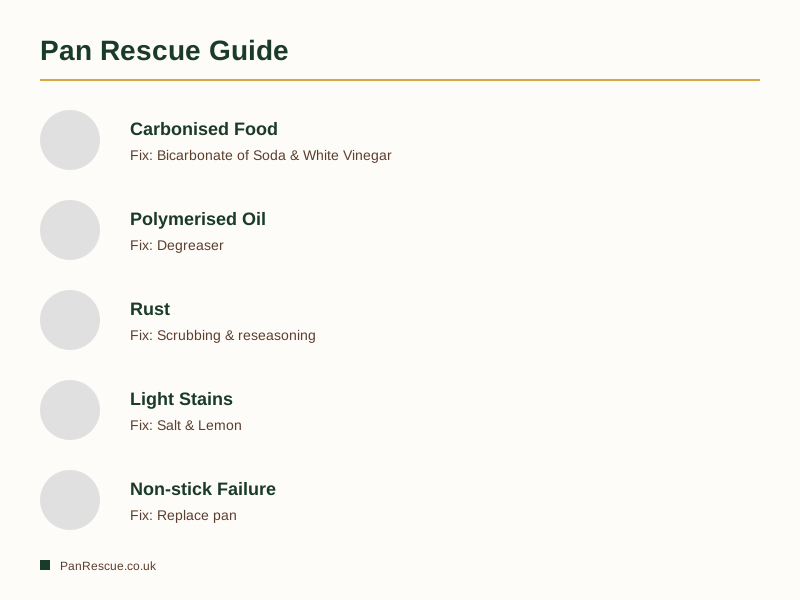
| Residue Type | What It Is | Best Natural Method |
|---|---|---|
| Carbonised Food | Black flakes from heavily baked-on food | Bicarbonate of Soda & White Vinegar |
| Polymerised Oil | Sticky brown/black film from overheated oil | Degreaser (beyond natural methods) |
| Rust | Oxidised metal on bare cast iron | Scrubbing & reseasoning |
| Light Stains | Brown marks or caramelised residue | Salt & Lemon |
| Non-stick Failure | Rough, scratched coating | Replace pan |
When natural methods aren’t enough
Natural methods have a clear boundary: they cannot remove polymerised oil buildup from certain surfaces like heavily carbonised aluminium or some types of enamel. For those situations, and for a complete overview of material-specific cleaning, see our parent guide: How to Clean a Burnt Pan: Stainless Steel, Aluminium and Pots .
Sources & Further Reading
- How to clean a burnt pan | Bosch UK
- Cleaning Burnt Frying Pan Natural Methods That Actually Work
- How to Clean Burnt Food Off Any Pan - Circulon UK
Note: General guidance only, verify details with a qualified professional or official source.