How to Season a Carbon Steel Pan or Wok and Why It Goes Blotchy
As an Amazon Associate we earn from qualifying purchases. Some links on this page are affiliate links, which means we may earn a small commission if you make a purchase.
Carbon steel’s thinner walls and higher thermal conductivity mean heat spreads unevenly across the surface during stovetop seasoning. This temperature variation causes oil to polymerise at different rates, creating the patchy appearance that often frustrates first-time users.
This patchiness is a common frustration with carbon steel seasoning, and it sends many people straight to Google looking for a fix. The short answer is that blotchy seasoning is usually a heat problem, not an oil problem. Understanding why changes what you do next — and whether you need to strip the whole lot off and start again.
Here is what that means in practice, and how to get a smooth, even surface on your pan or wok.
Understanding the Seasoning Process
Seasoning is a layer of polymerised oil bonded to the bare metal of your pan. It is not a coating you apply — it is a chemical change that happens when you heat oil past its smoke point. The oil molecules form a protective layer on the steel.
That layer does three useful things. It stops food from touching raw metal, which is why eggs don’t immediately weld themselves to the surface. It adds a measure of corrosion resistance. Because it is relatively non-stick, you use less fat and cleaning up is easier.
The crucial thing to understand is that seasoning isn’t permanent. Heat, acid, abrasive scrubbing, and time all wear it down. That’s normal. A seasoned pan is a living surface — it builds up over months of use and occasionally needs a top-up or a full re-season if things go wrong. Think of it less like a non-stick coating and more like the patina on a well-used cast iron skillet: it gets better the more you cook.
Seasoning Methods for Carbon Steel
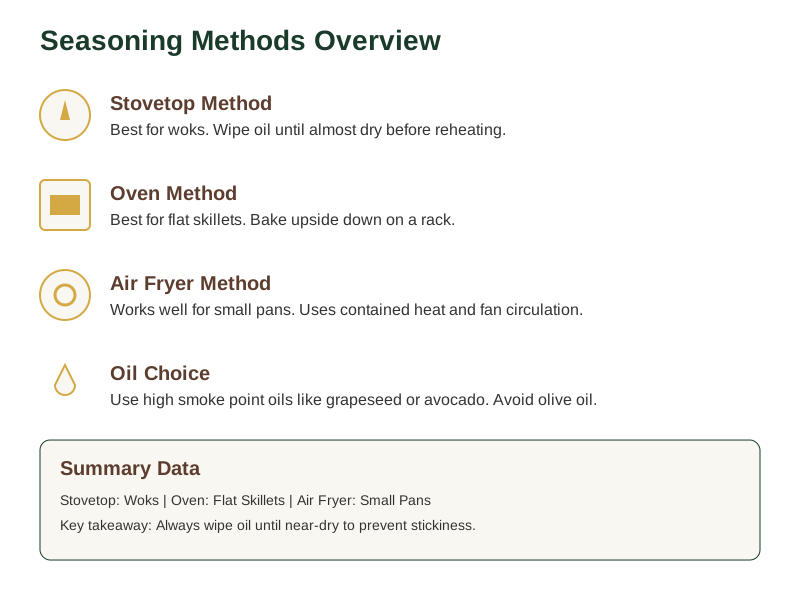
You can season carbon steel on the hob, in the oven, or in an air fryer. Each approach suits different situations.
📺 Watch: How To Season A Carbon Steel Wok
The stovetop method is most common for woks. Heat the pan until it’s barely smoking, remove from the heat, apply a very thin coat of high-smoke-point oil (grapeseed, avocado, or a high-heat vegetable oil), then return it to the heat for a minute or two until the oil stops being shiny. Wipe out the excess with kitchen roll — this step matters more than most people realise. Repeat this cycle three or four times.
The thing nobody stresses enough: the wipe-out step makes the difference between smooth and sticky. If the oil layer is too thick, it polymerises into a gummy mess rather than a hard shell. Wipe until the surface looks almost dry before you heat it again.
The oven method can heat the pan more uniformly than a concentrated stovetop burner. Heat your oven to around 200°C, place the pan upside down on a rack with foil on the shelf below to catch drips, and bake for an hour. Apply oil, heat, wipe, repeat — same principle as the hob method.
The air fryer method is an option for smaller pans that fit. The contained heat and fan circulation can produce a surprisingly even result.
For all three methods, a neutral oil with a high smoke point is the right choice. Grapeseed oil and avocado oil are reliable; refined sunflower or vegetable oil also works. Extra-virgin olive oil may be less convenient for high-temperature seasoning because its smoke point varies and can be relatively low.
Now you know the methods — Download the Free Pan Rescue First-Steps Checklist to keep the step-by-step sequence to hand at the hob.
Why Seasoning Becomes Patchy
This is the bit the generic guides skip over, and it’s why most people’s first season looks uneven.
Blotchy seasoning happens because the surface temperature of a carbon steel pan varies more than you might expect during stovetop seasoning. Carbon steel’s thin construction means it heats up and cools down quickly. On a gas hob, the flame creates a concentrated hotspot directly above the burner. Induction heating can produce uneven heating depending on the hob and pan. These hot spots reach the temperature needed for polymerisation while the rest of the pan is still too cool. The result is darker patches where the oil bonded, and lighter rings where it didn’t.
Cast iron’s greater thermal mass can make temperature changes slower, though uniformity still depends on the heat source. Carbon steel doesn’t have that luxury on a direct heat source — it is reacting to the flame or coil in real time.
What this means for your pan: blotchy seasoning is not a sign that you used the wrong oil or didn’t apply enough layers. It is a sign that the heat distribution during seasoning was uneven. The fix isn’t to strip and re-season with more oil — it is to season more gently, with lower heat, and to move the pan around the heat source if possible. On a gas hob, rotating the pan so different areas sit over the flame helps. On induction, working with shorter heating cycles and letting the pan cool slightly between them can even things out.
If the blotchiness is extreme — thick, sticky patches that sit proud of the surface — the oil layer was too thick and it is worth scrubbing back and starting again. But if it’s subtle variation in colour across a mostly smooth surface, the pan is fine. Cook with it. Each use adds to the seasoning, and the uneven areas will even out over time.
Choosing Between Pre-Seasoned and Unseasoned Pans
This is the point where a lot of buyers hesitate in the shop or on the product page. Do you pay extra for a pan that’s already seasoned, or do you save the money and do it yourself?
Pre-seasoned carbon steel — brands like Yosukata sell carbon-steel cookware in the UK — may come ready to cook with out of the box. Check whether the specific model is sold pre-seasoned. For a beginner, or for someone who just wants to get cooking without a faff, that’s a genuine advantage. A pre-seasoned pan may let you begin cooking sooner, subject to the manufacturer’s instructions. The trade-off is that factory seasoning may be thinner than what you build yourself over time. If you use a pre-seasoned carbon steel pan (paid link)See on Amazon for a while, it is worth adding another round or two of your own seasoning to build a thicker, more durable patina.
Unseasoned carbon steel — such as products from Ken Hom or Wahei Freiz — requires that first seasoning session before you cook on it. This is the honest cost of the lower price: you put the work in. What you get for that work is a surface that’s entirely yours, built to your heat habits and cooking style. Over time, regular use on an unseasoned pan develops a patina that’s genuinely hard to replicate with a few quick oven sessions.
The honest call depends on how you’ll use the pan. If you’re new to carbon steel and want to learn how the pan responds before committing to building a patina, start with pre-seasoned and treat it as a learning tool. If you cook with carbon steel regularly and want the most durable, custom-seasoned surface possible, go unseasoned and do the work yourself. Either way, the pan is not finished after the first seasoning — it improves with use.
Solving Common Seasoning Problems
Rust is the most alarming issue and the one most likely to send people into a panic. It appears as orange-brown bloom, usually after the pan has been left wet or stored in a damp cupboard. The fix is straightforward: scrub the rust off with a mild abrasive (a chainmail scrubber (paid link)See on Amazon works well on carbon steel), dry the pan immediately and thoroughly, then re-season. Don’t leave the pan to air-dry — use a cloth or put it back on the heat for a minute to drive off any moisture. Rust indicates that moisture remained on the steel or that the protective layer was insufficient.
Sticky residue after seasoning almost always means the oil was applied too thickly or the heat wasn’t high enough. The oil hasn’t polymerised — it is just baked onto the surface. Heat the pan until it is smoking, then wipe it out aggressively with kitchen roll. You may need to repeat this a few times. If the residue is particularly thick, a plastic scraper (paid link)See on Amazon can help lift it before you re-season.
Staining and discolouration are cosmetic unless the surface is rough to the touch, flaking, or visibly damaged. Heat marks, mineral marks from hard water, and general darkening are all normal. They don’t affect cooking performance and don’t need treating unless you want the pan to look pristine.
Common Questions About Carbon Steel Seasoning
📺 Watch: The only guide you need…seasoning & maintaining your carbon …
Can I put my carbon steel pan in the dishwasher?
No. Hand-wash only. Manufacturers commonly advise hand-washing because dishwasher detergents and prolonged wetting can damage seasoning and promote rust. Wash with hot water and washing-up liquid, dry immediately with a cloth or over low heat, and your pan will last for decades.
What oil should I use for seasoning?
A neutral oil with a high smoke point: grapeseed, avocado, or a refined vegetable or sunflower oil. Avoid olive oil, butter, and anything labelled “extra virgin” — they smoke at lower temperatures and leave sticky deposits rather than a hard polymerised layer.
How often should I re-season my pan?
Whenever the surface looks dull, feels sticky after cooking, or starts to show bare metal patches. Re-season when the surface becomes sticky, dull, or exposes bare metal. The more you cook, the more the surface builds itself up naturally.
Can I use olive oil for seasoning?
No. Olive oil has a lower smoke point and a different fatty acid profile that doesn’t polymerise cleanly on steel. You’ll get a sticky, uneven layer rather than a hard seasoning. Stick to grapeseed, avocado, or a high-heat vegetable oil.
Is blotchy seasoning permanent?
No. If the patchiness is mild — uneven colour across a smooth surface — cook with the pan and it will even out over time. If the patches are thick, sticky, or sitting proud of the surface, scrub the pan back with hot water and a mild abrasive, dry it, and re-season. The pan isn’t ruined; it just needs another go.
Moving Forward with Carbon Steel
Blotchy seasoning is one of the most common first encounters with carbon steel, and it catches people out precisely because the generic advice online doesn’t explain the mechanism behind it. It isn’t poor technique and it isn’t a bad pan. It is physics: uneven heating can cause darker seasoning where the pan is hottest. Knowing this means you stop stripping the pan and starting again every time, and start working with the heat instead of against it.
A few more cooks on the pan, a light re-season when it looks dull, and the surface will build into something genuinely non-stick. Carbon steel rewards patience in a way that non-stick coatings — which degrade and eventually get thrown away — simply don’t.
Carbon steel is ready to cook on when it shows an even dark-brown or black tone with no pale rings, not when it looks like cast iron’s near-black finish. Our main guide covers cast iron seasoning in detail, with the key difference for carbon steel being the stovetop rotation method to combat uneven heating. For the complete process, see How to Season a Cast Iron Pan (and When to Re-Season) .
Sources & Further Reading
- Season Carbon Steel Wok
- Carbon Steel Woks & Wok Pans - Yosukata
- How to Season Your Carbon Steel Wok - Season Cookshop
Note: General guidance only, verify details with a qualified professional or official source.