How to Season a Cast Iron Pan (and When to Re-Season)
As an Amazon Associate we earn from qualifying purchases. Some links on this page are affiliate links, which means we may earn a small commission if you make a purchase.
Food sticking despite correct heat, dull grey patches on the cooking surface, water not beading on the surface. These three signs mean your cast iron pan’s seasoning needs attention.
The pan isn’t ruined. It’s just dirty—or more specifically, it has a build-up of soft, half-hardened oil on the surface that was never given the right conditions to polymerise into a proper non-stick coating. Fixing it takes less time than you think, and the missing step is simpler than any guide has told you.
This guide explains what seasoning actually is, why it goes wrong, which re-seasoning method fits your pan and your kitchen, and—honestly—when to stop and buy a new one.
Understanding the Seasoning Process
Seasoning is not a flavour. It is not a coating you apply once and forget. It is a thin, fat-based layer on the surface of the pan that, when heated to a high temperature, forms a coating on the iron—a process called polymerisation—and stops food from sticking and the pan from rusting. BBC Good Food
📺 Watch: The Easy Guide On Seasoning and Restoring Cast Iron
Most pans arrive pre-seasoned from the factory. That’s a genuine base coating, but it is not maintenance-free. Over time, washing with water, occasional soap, air drying, and general use all wear at that layer. The pan doesn’t suddenly fail—it goes dull, then tacky, then starts sticking. That’s not the pan dying. That’s the seasoning degrading, and it needs rebuilding.
A note on soap: the old idea that you must never use washing-up liquid on cast iron comes from the days of lye-based soaps that would strip the seasoning entirely. Modern washing-up liquid is far milder. A small amount is fine for cleaning; just don’t use it repeatedly on the same spot without rinsing thoroughly, as it can gradually break down the polymerised layer over time. The pan can take a wash—what it can’t take is being left wet. Phil Leigh Way
So, to be clear: seasoning is a living process, not a one-time event. Your pan needs looking after the same way any piece of cookware does. If you’re dealing with a burnt-on base right now, the quick guide to how to clean a burnt pan covers the soak-and-scrape method before you even think about re-seasoning.
The Critical Mistake: Thick Oil and Sticky Results
Most tutorials tell you to oil your pan and then heat it. That’s not wrong—but it is incomplete. The critical instruction they leave out is this: wipe the oil off until the pan looks dry before you put it anywhere near heat. If you can see oil, the layer is too thick.
Polymerisation requires a molecularly thin layer of oil. When oil sits in a visible pool or a thick coat on the surface, the heat cannot penetrate the full droplet. The top of the oil polymerises; the underneath stays soft and tacky. You end up with a surface that feels slightly gummy, looks unevenly shiny, and sticks to everything. It is not seasoning. It is failed seasoning—a build-up of half-hardened fat that sits on the iron instead of bonding to it.
The test is visual: if the pan looks wet, wipe it again. Serious Eats puts it plainly—buff the oil off as if you’re trying to wipe it off entirely. What you’re left with is a pan that looks almost dry but has a microscopically thin layer of fat still on the surface. That is the layer that will polymerise properly when heated. Serious Eats
This is the most common mistake. You oil the pan, you see a nice even shine, and you put it in a hot oven. An hour later you open the door and find a slightly sticky patch in the centre. That’s not a bad pan. That’s a thick oil layer that never fully hardened. The fix is to strip it back—warm soapy water and a scrubber—and start again with a thinner coat.
Choosing Your Re-Seasoning Approach
Three practical approaches exist for re-seasoning a cast iron pan. The right one depends on your pan and what you’re trying to fix.
Quick Fix on the Hob
This is the fastest option. Heat your pan on the hob—high heat for a minute or two—then apply a very thin coat of oil with a cloth or paper towel. Wipe it off until the surface looks dry. Heat again until the oil starts to smoke, then let it cool. Repeat two or three times.
It works well for skillets and flat frying pans where the cooking surface gets direct, even heat. It is not suitable for casseroles, Dutch ovens, or anything with a thick base—the heat doesn’t distribute evenly enough on a hob for the sides and base to season at the same rate. And if your pan has a wooden handle that you cannot remove, skip this method: direct hob heat can scorch or crack wood, and some wooden handles are not designed for sustained high temperatures. Netherton Foundry
For induction hobs, this method works fine—use a high heat setting and keep an eye on the temperature. Gas and electric hobs are more straightforward since you can see and control the heat directly.
Thorough Restoration in the Oven
This approach gives the most complete, even finish—closer to a factory re-season. Preheat your oven to around 200°C (180°C fan). Remove the handle if it is detachable and not heatproof. Apply a very thin coat of high-smoke-point oil—rapeseed (paid link)See on Amazon works well in the UK—wipe it off until dry, and place the pan upside down on the middle shelf with a baking tray on the shelf below to catch any drips. Bake for one hour, then let it cool completely in the oven.
The oven method creates a near “factory” finish because the entire pan heats evenly, including the sides and any vertical surfaces that a hob flame can’t reach. It is the better choice for heavier pans, cast iron casseroles, and pans with non-removable handles you want to protect. Netherton Foundry
The trade-off is time—you’re looking at an hour in the oven plus cooling, and you need to be around to manage it. For a pan that needs full restoration rather than maintenance, it’s worth it.
Daily Upkeep Without Heat
This is not a full re-season. It’s the habit you build after every use to keep the coating strong. After washing and thorough drying—and I mean thoroughly, every trace of moisture—apply a very thin smear of oil to the cooking surface with a cloth and buff it dry. That’s it. No heat required. Do this after every wash and the pan’s seasoning will improve incrementally over time. Phil Leigh Way
For most people using their cast iron regularly, this is the method that matters most. A quick dry-and-oil after washing takes thirty seconds and means you are far less likely to need a full re-season ever again.
How to Choose the Right Method
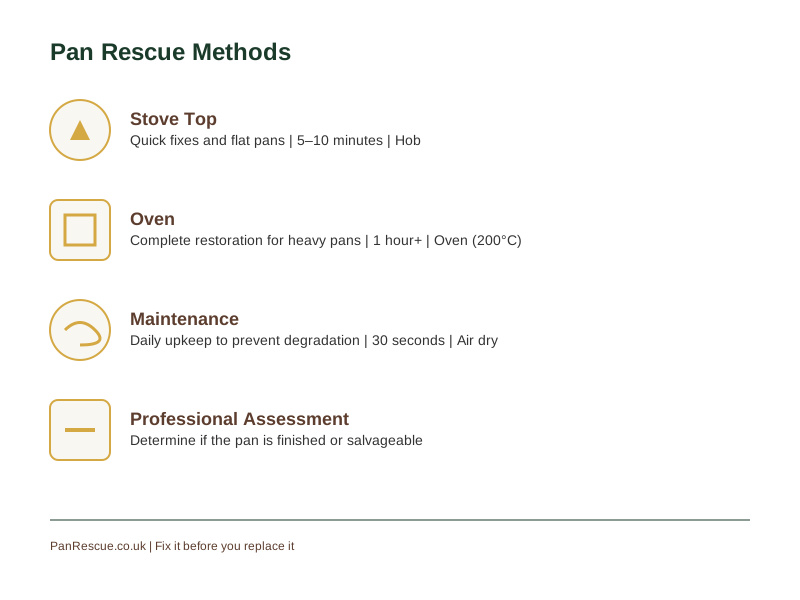
It depends on the situation. If you’ve just bought a new pan and want to build on the factory seasoning, maintenance seasoning after each use is all you need. If your pan is dull and sticks occasionally, a couple of rounds on the hob will probably sort it. If it’s heavily degraded—sticky patches, rust spots, or a patchy finish—the oven method is the one that will actually restore it properly. The best method for you depends on the pan and the problem: a quick stove-top fix is ideal for skillets needing minor attention, while the oven provides the most thorough restoration for heavier pans, requiring about an hour plus cooling time. The maintenance method, requiring no heat, is for daily upkeep.
If you’re wondering whether carbon steel suits you better, the guide to seasoning a carbon steel pan shows how similar the routine is.
Knowing When a Pan Is Beyond Saving
Most cast iron can be rescued. Not all of it.
A few situations exist where re-seasoning won’t work and you should consider replacement.
Rust that won’t shift. A light rust bloom—orange, surface-level—can be removed with a rust eraser or fine steel wool (paid link)See on Amazon, then washed, dried, and re-seasoned. If the rust has pitted the iron deeply, the surface beneath will always be rough and the seasoning will never hold evenly. That pan has done its job.
Persistent sticking that doesn’t resolve. If you’ve worked through the re-seasoning methods properly—thin oil, proper heat, multiple rounds—and food still sticks consistently, the iron surface itself may be damaged or too rough to develop a good polymerised layer. At that point you are fighting the pan rather than cooking with it.
Warping or cracking. Cast iron is brittle under sudden thermal shock—dropping a red-hot pan into cold water, or heating an empty pan too fast on high heat, can crack or warp it. A warped base will rock on the hob and heat unevenly. A cracked pan should be retired. These are structural failures, not seasoning problems, and no amount of oil and heat will fix them.
Deep chips in enamelled cast iron. If the interior enamel of a Le Creuset or Staub-style pan has chipped through to the iron, stop using it and follow the manufacturer’s replacement or support guidance. Enamelled cast iron generally requires no seasoning, and damaged interior enamel should not be used. Staub
The honest rule: if you’ve restored the pan properly—stripped back the bad seasoning, removed rust, re-seasoned in the oven—and it still doesn’t perform, it is worth asking whether the age and history of the pan mean it is time for a new one. That is not failure. It’s just cookware wearing out, the same as anything else.
If your pan is genuinely done, the guide to disposing of old pans covers the practical UK options, including scrap metal recycling and charity donation where the pan is structurally sound.
Common Seasoning Questions Answered
Which oil should I use to season my cast iron pan?
Neutral oils with a high smoke point are best—rapeseed oil is readily available in the UK and works well. Grapeseed oil and sunflower oil are also good options. Avoid olive oil and butter, as their lower smoke points can lead to a sticky finish; choose an oil recommended by the pan manufacturer and follow its temperature guidance.
Can I use washing-up liquid on cast iron?
A small amount of washing-up liquid is fine for cleaning. Avoid using it as your regular method—warm water and a scrubber is usually enough for day-to-day washing—but the occasional wash with soap will not destroy your seasoning, especially if you follow it with a thorough dry and a light oil coat. What damages cast iron more than soap is being left wet. Dry it properly after every wash. Phil Leigh Way
How often is re-seasoning necessary?
If you use the maintenance method—a thin oil coat after every wash—you may never need to do a full re-season. If you notice food starting to stick, or spot rust forming, that’s the signal to re-season. It is not a scheduled maintenance task; it is a response to what the pan looks and feels like.
Your Next Steps in Pan Care
This guide is part of a hub of articles tackling specific cast iron problems. Use the list below to find the exact advice you need next.
- Why Is My Cast Iron Pan Sticky After Seasoning? – Diagnoses the causes of a sticky finish and how to fix it.
- Can You Use Washing-Up Liquid on Cast Iron? – Explains the modern reality of soap and cast iron care.
- How to Remove Rust From a Cast Iron Pan Without Ruining It – A step-by-step guide for rust removal.
- How to Clean a Cast Iron Pan After Cooking – Covers daily cleaning routines.
- How to Season a Carbon Steel Pan or Wok and Why It Goes Blotchy – Compares seasoning for carbon steel.
Download the Free Pan Rescue First-Steps Checklist to keep the key steps to hand while you work through a restore.
Related Guides
- Why Is My Cast Iron Pan Sticky After Seasoning?
- Can You Use Washing-Up Liquid on Cast Iron?
- How to Remove Rust From a Cast Iron Pan Without Ruining It
- How to Clean a Cast Iron Pan After Cooking
- How to Season a Carbon Steel Pan or Wok and Why It Goes Blotchy
- How to Fix Flaking Seasoning on a Cast Iron Pan
- How to Season Cast Iron on an Induction Hob Without an Oven
- How to Rescue a Neglected Cast Iron Pan From a Car Boot or Attic
- How to Season a Cast Iron Griddle for Pancakes and Steaks
- My Cast Iron Pan Was Left in Water — Is It Ruined?
- Why Does My Cast Iron Pan Smoke When Heating?
Explore More Topics
Quick answers:
Sources & Further Reading
- How to season cast iron - a guide by BBC Good Food cookery experts
- Re-seasoning and care of spun iron, black iron and cast iron …
- How to Season a Cast Iron Pan (It’s Easier Than You Think!)
Note: General guidance only, verify details with a qualified professional or official source.