When to Throw Away a Scratched Non-Stick Pan
As an Amazon Associate we earn from qualifying purchases. Some links on this page are affiliate links, which means we may earn a small commission if you make a purchase.
A scratch that catches your fingernail and shows a bright metallic line has likely reached the pan’s substrate—that’s the threshold between a cosmetic mark and a structural problem. This distinction matters more than the number of scratches.
Many guides simply state that scratches mean it’s time to replace your cookware, but they rarely explain the practical difference between a surface mark and a failure that affects cooking. You don’t need to panic, but you do need to know if your pan is still doing its job. Here is how to tell if your non-stick is finished or just looking a bit tired.
Understanding the coating and what fails
To assess a scratch properly, you need to know what a non-stick coating actually is. Most modern pans use PTFE (polytetrafluoroethylene), a polymer designed to be incredibly slippery. The common fear is that a scratched coating becomes dangerous, but for care purposes, the real question is whether the pan still works.
The actual issue is degradation. PTFE breaks down when exposed to excessive heat or heavy abrasion. When the coating begins to fail, it doesn’t just “scratch”—it can blister, peel, or flake. Once that happens, the “non-stick” part of the equation vanishes.
Think of the coating as a very thin skin. When you use a metal spatula, you aren’t just “marking” the surface; you are potentially slicing through this protective layer. This is why a few light marks might be fine, but a deep gouge changes how the pan performs.
The practical scratch test
The key is distinguishing a “cosmetic” mark from a “functional” one. Look at the colour and feel of the scratch.
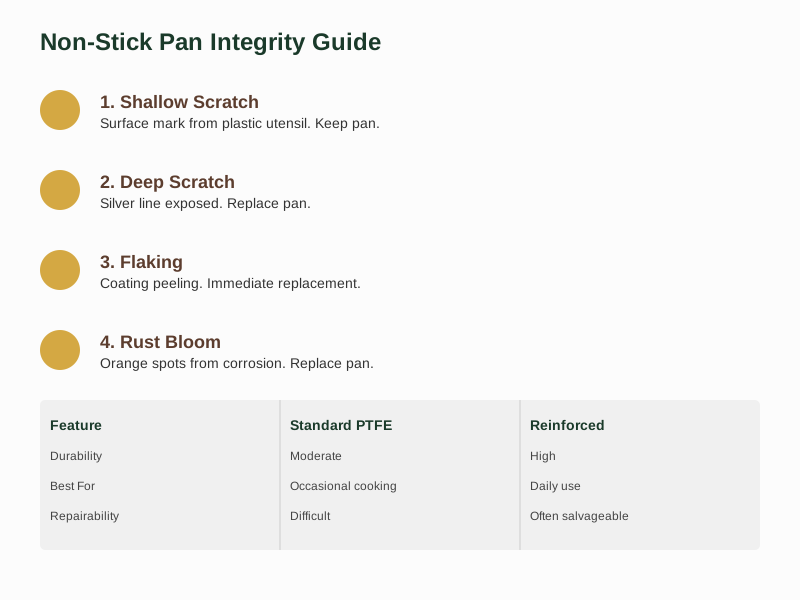
A shallow scratch is typically a duller version of the coating colour. It’s a surface score—often caused by a plastic utensil or a soft sponge—that hasn’t penetrated the full thickness. If the pan still releases food easily and there is no visible metal, it is purely cosmetic. Keep it.
A deep scratch is different. If you see a bright silver or grey line, you may have cut through to the underlying aluminium or steel. This creates a weak point. Food will stick to that spot, and damage may allow gradual erosion of the surrounding coating.
Your decision should match how you use the pan:
- The Occasional Cook: If you only use the pan once a week for eggs and the scratches are few, you can keep it until sticking becomes a genuine nuisance.
- The Daily User: If this is your “workhorse” pan, a few deep scratches are a signal to replace it. Performance will drop rapidly, and you’ll spend more time scrubbing than cooking.
- The Budget-Conscious: If you’ve invested in a pan with reinforced technology, you might find it looks scratched but still performs. Judge each pan by how it cooks, not just how it looks.
The honest verdict: a single shallow scratch from a plastic utensil is not a reason to bin the pan; multiple deep scratches that expose the underlying metal are. The decision hinges on performance and the likelihood of flaking.
Now you know whether your pan is a keeper or a candidate for the bin—Download the Free Pan Rescue First-Steps Checklist to help you assess the rest of your cookware.
Cleaning a pan with surface marks
If your scratches are shallow and the pan is just dirty rather than damaged, you can usually restore the surface. The mistake is reaching for heavy-duty abrasives first, which can turn a shallow scratch into a deep one.
📺 Watch: It’s Time to Throw Away My Nonstick Teflon Pan (Scratched …
Start with the gentlest approach. Cool the pan completely, then soak it in warm soapy water. Le Creuset suggests a 15–20 minute soak for stubborn residue on non-stick cookware. Never plunge a scorching hot pan into cold water, as thermal shock can warp the base or crack the coating.
If burnt-on carbon remains, a bicarbonate of soda paste (paid link)See on Amazon is a mild option. Apply it gently and let it sit. Use a plastic scraper or a soft sponge for scrubbing. Avoid the abrasive side of heavy-duty sponges.
Avoid these common errors:
- Steel Wool: Brillo pads or steel wool are for stainless steel, not non-stick.
- Metal Utensils: Once you start using metal, you accelerate wear.
- Harsh Chemicals: Avoid oven cleaners or strong acids unless the label explicitly says they are safe for PTFE.
If you regularly fight burnt-on residue, check your heat settings. Using low to medium heat helps prevent the polymerised oil buildup that makes pans feel sticky.
Clear signs it’s time to replace
There comes a point where rescue is no longer an option. A damaged non-stick coating generally cannot be restored to its original condition.
Retire your pan immediately if you see any of these:
- Flaking or Peeling: If the coating comes off in small shards, the pan is finished.
- Blistering: Small bubbles mean the coating has detached from the metal, usually from overheating.
- Rust Spots: If you see orange or brown spots emerging from a scratch, the underlying metal is corroding.
- Persistent Sticking: If food grips the pan despite using oil and gentle cleaning, the non-stick properties have degraded.
When it’s time to let go, remember that most non-stick pans are made of aluminium or steel. Check your local council’s current recycling and disposal guidance for how to dispose of them responsibly.
If you’re looking for a replacement, you have options. Standard PTFE pans are common, while reinforced ranges are designed to resist scratches and maintain performance for longer, subject to care. Those wanting more durable cookware might consider carbon steel or cast iron, which can be very durable with proper maintenance.
Questions we often hear
Can I keep using a scratched non-stick pan?
The practical problem is that it stops being non-stick and may start flaking more. Judge it on performance and replace it once the coating fails. For specific guidance, check the manufacturer’s care page.
Can I use Bar Keepers Friend on a scratched non-stick pan?
Generally, no. Bar Keepers Friend is excellent for stainless steel but too abrasive for most non-stick coatings. Only use it if your pan’s label explicitly permits abrasive cleaners.
How do I know for sure if a scratch is “deep”?
Run your fingernail gently across the scratch. If you feel a distinct catch or sharp edge, and you see a bright, metallic colour beneath the grey coating, it is likely deep.
Comparing non-stick pan types
| Feature | Standard PTFE | Reinforced (e.g. Scratch Guard) |
|---|---|---|
| Durability | Moderate; scratches can appear | Designed to resist scratches and maintain performance for longer, subject to care |
| Best For | Occasional cooking | Daily use and heavier handling |
| Performance | Good initial release | Aims for consistent release over time |
| Assessment | Replace when coating fails or sticks | Judge by actual cooking performance, not just marks |
📺 Watch: I Scratched My Teflon Nonstick Pan / Is It Still Safe To Cook With?
Making the final call
Deciding whether to keep or bin a pan usually comes down to a simple trade-off: is the frustration of a sticking pan worse than the cost of a new one? If you’ve got shallow marks and the food still slides, there’s no reason to waste money on a replacement. But if you’re seeing silver lines and flaking, the pan has done its job.
The goal is to move from panic to practical assessment. By matching your cleaning method to the material and knowing the difference between a surface mark and a structural failure, you can make your cookware last longer.
Now that you’ve sorted your non-stick, apply the same logic to the rest of your kitchen. Download the Free Pan Rescue First-Steps Checklist to help you identify and rescue your other pots and pans.
Related guides
For a complete overview, see our Non-Stick Pan Rescue: When to Save It and When to Bin It .
Sources & further reading
- Experts reveal when you should replace your non-stick pans
- PTFE - All about our non-stick material - Tefal
- How to Clean Non-stick Pans | Tefal UK Shop
Note: General guidance only, verify details with a qualified professional or official source.